6-12 Months

Your baby is becoming
an explorer.
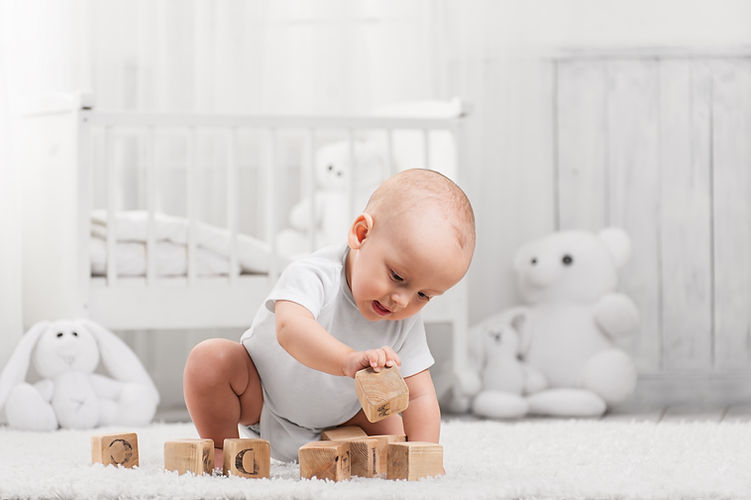
This stage is full of movement, curiosity, and communication. Babies begin sitting, crawling, pulling to stand, and exploring everything around them. They also become more aware of people, language, and the world, learning through play, songs, and everyday interactions.
During this stage, your baby may respond to their name, play peek-a-boo, wave goodbye, and communicate through sounds, gestures, facial expressions, and pointing. Every interaction helps build their language, social, and thinking skills.
Free Parent Resource
As your baby begins communicating before they have all the words, offering simple choices encourages language and connection.
Download our FREE Visual Jukebox, where your child can point to the songs they want to hear while building communication, choice-making, and shared moments through music.

6-12 Month Milestones
Development in how children use and control their bodies. Including muscle and motor skills.
Physical
-
Rolls from tummy to back.
-
Leans on hands to support when sitting.
-
Gets to sitting position by themselves.
-
Moves things from one hand to the other.
-
Uses fingers to “rake” food.
-
Sits without support.
-
Pulls up to stand.
-
Walks holding on to furniture.
-
Drinks from a cup without a lid (with help).
-
Picks things up between thumb and pointer finger.
-
Crawls on hands and knees.
-
Transfers object from hand to hand.
-
Uses pincer grasp to lift small objects.
-
Stands briefly with support.
-
Takes first steps with assistance.
-
Bangs objects together.
Social & Emotional
-
Likes to look at self in mirror.
-
Shows stranger anxiety.
-
Enjoys interactive games like peek-a-boo.
-
Shows affection with hugs or kisses.
-
Expresses emotions like joy or frustration.
-
Begins parallel play with others.
-
Shows preference for familiar people.
-
Offers comfort by touching.
-
Seeks adults for support.
-
Recovers from distress in secure relationship.
-
Plays confidently in presence of caregiver.
-
Frequently checks in with caregiver (social referencing).
-
Shows pleasure in mastery of tasks.
-
Distinguishes known people from strangers.
-
Begins to sense behavior affects others.
-
Expresses anger, anxiety, fear, sadness (emerging).
Cognitive
-
Puts things in mouth to explore.
-
Reaches to grab a toy.
-
Closes lips to show doesn’t want more food.
-
Looks for objects when dropped out of sight.
-
Bangs two things together.
-
Puts something in a container.
-
Looks for things hidden.
-
Finds hidden objects.
-
Imitates actions like waving or clapping.
-
Explores how objects work (banging, shaking).
-
Uses objects as tools (pulls string to get toy).
-
Solves problems by trial and error.
-
Imitates adult behavior (e.g., copying gestures).
-
Takes part in pretend play with simple scenarios (e.g., caring for dolls).
-
Shows increasing awareness of cause and effect.
Communication
-
Makes different sounds like “mamamama”, “babababa”.
-
Lifts arms to be picked up.
-
Waves “bye-bye”.
-
Calls parent “mama” or “dada”.
-
Understands “no”.
-
Babbles with consonant sounds.
-
Says first word with meaning.
-
Responds to simple words like “no” or “up”.
-
Points to direct attention.
-
Uses gestures (waving, pointing).
-
Takes turns in simple games like peekaboo.
-
Uses vocalizations to maintain connection across space.
-
Checks in with caregiver using eye contact.
-
Shares attention with adult on same object or photo.
-
Shakes head to mean “no”.
-
Uses gestures to show object purpose (e.g., pretending to drink).
Our Favourite Toys for This Stage

Sensory Balls
-
Encourages reaching, rolling, and crawling
-
Builds grasping and hand-eye coordination
-
Supports sensory exploration through texture

Farm Animals
-
Builds language and animal recognition
-
Encourages pretend play and imagination
-
Supports fine motor development

Busy Board
-
Develops fine motor skills and hand strength
-
Encourages problem-solving and curiosity
-
Supports independence through practical play

Pickler Climber
-
Builds strength and coordination
-
Encourages climbing and active movement
-
Supports balance and body awareness

Blocks
-
Builds grasping and hand-eye coordination
-
Encourages reaching, stacking, and knocking down
-
Supports problem-solving and cause-and-effect learning

Push Cars
-
Encourages crawling and active movement
-
Builds hand-eye coordination
-
Introduces cause-and-effect play

Tunnel
-
Encourages crawling and active movement
-
Builds coordination and body awareness
-
Supports confidence and spatial awareness

Stacking Cups
-
Builds grasping and hand-eye coordination
-
Encourages stacking and cause-and-effect play
-
Supports problem-solving and spatial awareness

Peg Puzzles
-
Builds grasping for fine motor and eating skills
-
Supports hand-eye coordination
-
Encourages matching and problem-solving